Through-floor lifts and home lifts
Home lift grant: get a home lift quote and see it against the limit
There is no grant called a home lift grant. In England the government’s guidance says help with larger items such as through-floor lifts normally comes through the council’s Disabled Facilities Grant (government guidance to councils, checked 13 November 2026), and one grant has to be no more than £30,000 (GOV.UK, checked 12 November 2026). Ask us for a quote for the lift, and set it against what a grant can reach where you live.
Last reviewed against its sources: 13 November 2026. Every price below is one supplier’s own figure on that day.
Before you ask for a lift
- The council judges the needThe work has to be necessary and appropriate for the disabled person, and reasonable and practicable in that building (GOV.UK, checked 12 November 2026).
- The limit is a ceilingIt is the most one grant has to be, not a sum anyone is owed; a council may go further under its own policy (consultation response, checked 13 November 2026).
- No VAT for a disabled personInstalling a lift to help them move between floors of their home carries no VAT (GOV.UK, checked 13 November 2026).
- Each nation differsWales and Northern Ireland set higher limits, and Scotland pays a share of the cost instead. The figures are below.
Order nothing before the council approves. Work started first may get no grant at all (GOV.UK, checked 12 November 2026). Asking for a quote is not ordering.
Published prices
What UK suppliers print for a through-floor lift
On the makers’ and suppliers’ own pages read on 13 November 2026, sellers printed single prices for a through-floor lift and several makers printed a starting figure; others printed none. One maker’s cost page says plainly that it is unable to give an exact figure, because the type of lift, the work to prepare the home, the number of floors and even the lights and displays inside the car all move the cost (Vimec, checked 13 November 2026).
-
Stannah Lifts (maker), through-floor home lifts
From £15,000
Including building works, as its page puts it; VAT not stated (Stannah Lifts, checked 13 November 2026).
-
Pollock Homelifts (maker), ground to first floor
From around £13,995
To £16,000 by size and specification, including the basic preparatory work (Pollock Homelifts, checked 13 November 2026).
-
Stiltz (maker), home lifts
From £17,000
Excluding VAT; the page says the price covers manufacture, delivery, professional installation and a 12-month warranty (Stiltz, checked 13 November 2026).
-
Millercare, through-floor lift
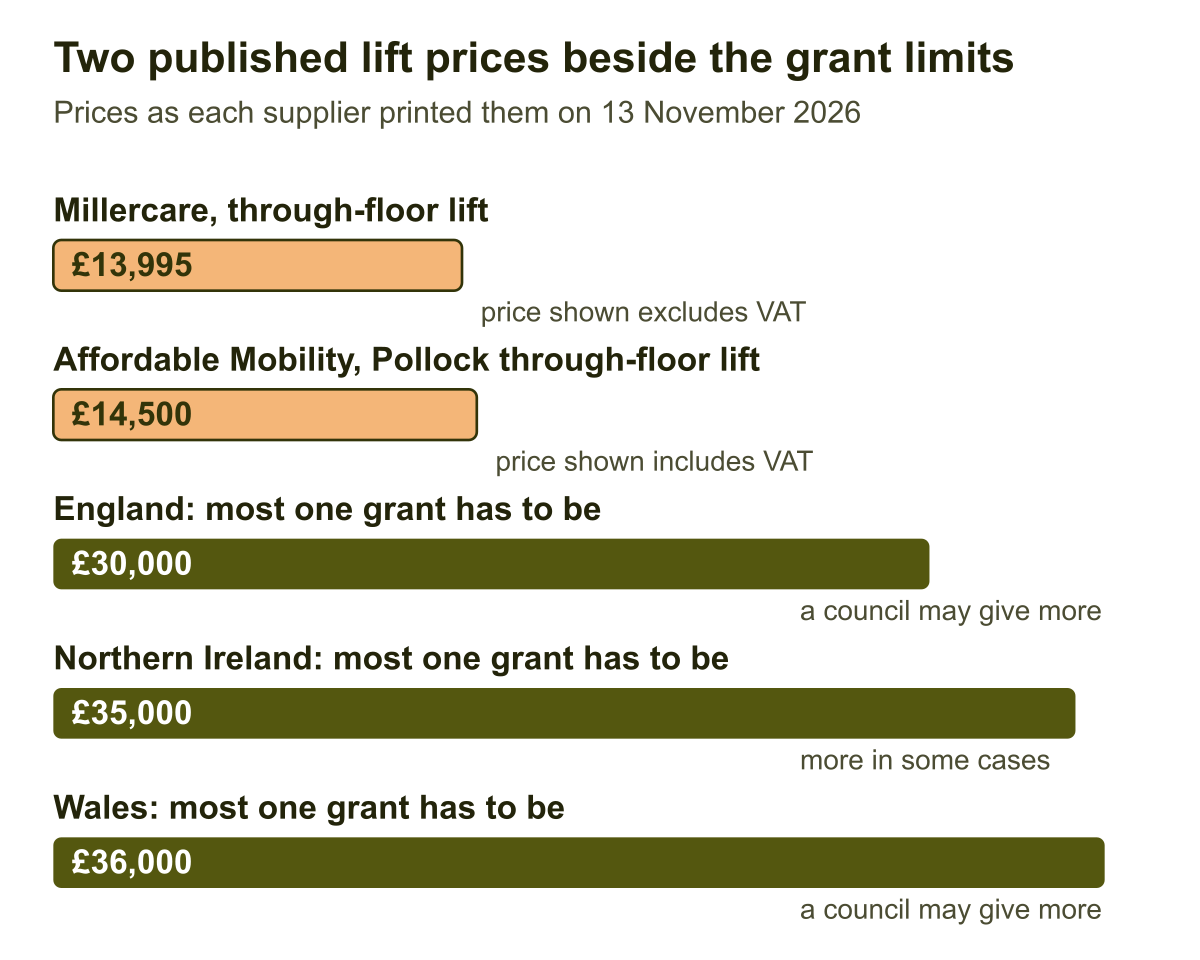
£13,995
With the VAT relief applied: the page says the price shown already excludes VAT. It lists a 1 year warranty and travel up to 4.2m (Millercare, checked 13 November 2026).
-
Affordable Mobility, Pollock through-floor lift
£14,500
Including VAT, as the page shows it. Travel up to 4.2 metres and a maximum capacity of 255kg, one person (Affordable Mobility, checked 13 November 2026).
| Published price | VAT on the page | Under England’s limit? | Source |
|---|---|---|---|
| Millercare, £13,995 | Excluded (relief applied) | Yes: limit £30,000 | (Millercare, checked 13 November 2026) |
| Affordable Mobility, £14,500 | Included | Yes: limit £30,000 | (Affordable Mobility, checked 13 November 2026) |
The prices are not shown on the same terms: some exclude VAT, some include it, some include building work and some are only a starting point. Read each as its own firm printed it. What each one covers, and what tends to come on top, is set out on through-floor lift cost; every price we found, and which makers print none, is on home lift cost in the UK.
The grant’s ceiling
The most one grant has to pay, in each nation
A limit is the most a council or the Housing Executive has to pay for one grant. It is not what anyone will be given: the work still has to pass the council’s tests, and in England the amount usually depends on income and savings as well (GOV.UK, checked 12 November 2026).
England
£30,000
From your council, which may give more (GOV.UK, checked 12 November 2026).
Wales
£36,000
From your council, set by the Welsh order (legislation.gov.uk, checked 12 November 2026).
Northern Ireland
£35,000
From the Housing Executive, on a low income; £70,000 in some cases (nidirect, checked 13 November 2026).
Scotland
80%
At least this share of the approved cost, and 100% on certain benefits (legislation.gov.uk, checked 12 November 2026).
Both published prices above sit under every money limit. A full quote with building work may not; the top-up calculator sets your own quote against your nation’s figure, and grants by nation explains each nation’s rules for a lift.
Fitting one in
How a through-floor lift fits into a home
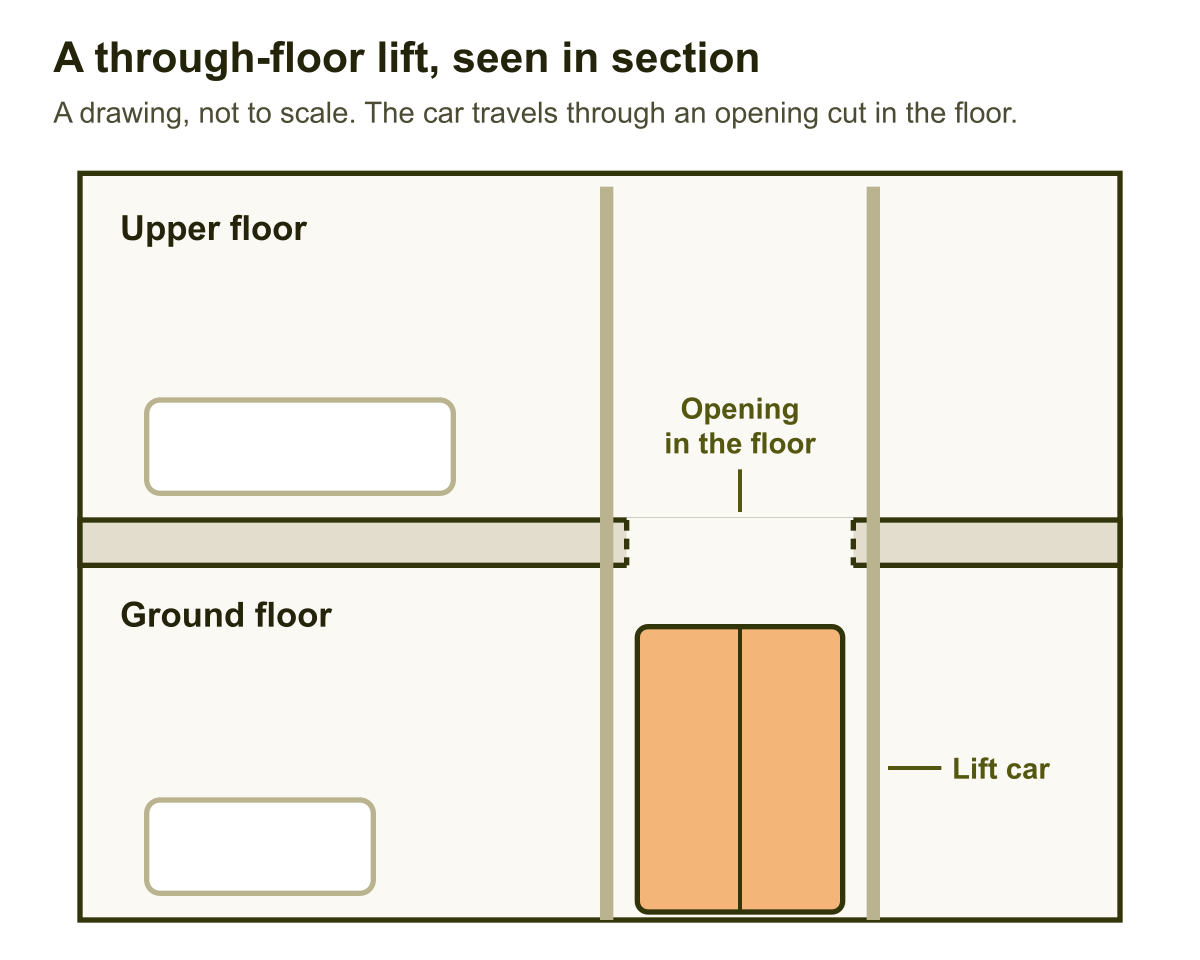
A through-floor lift carries one person between two floors in a car that runs up through an opening in the ceiling below and the floor above. The suppliers’ pages describe seated versions and versions large enough for someone to stay in a wheelchair (Affordable Mobility, checked 13 November 2026), and both give travel of up to 4.2 metres. Millercare’s page adds that when the lift is not in use it can rest on the upper floor, leaving the room below free.
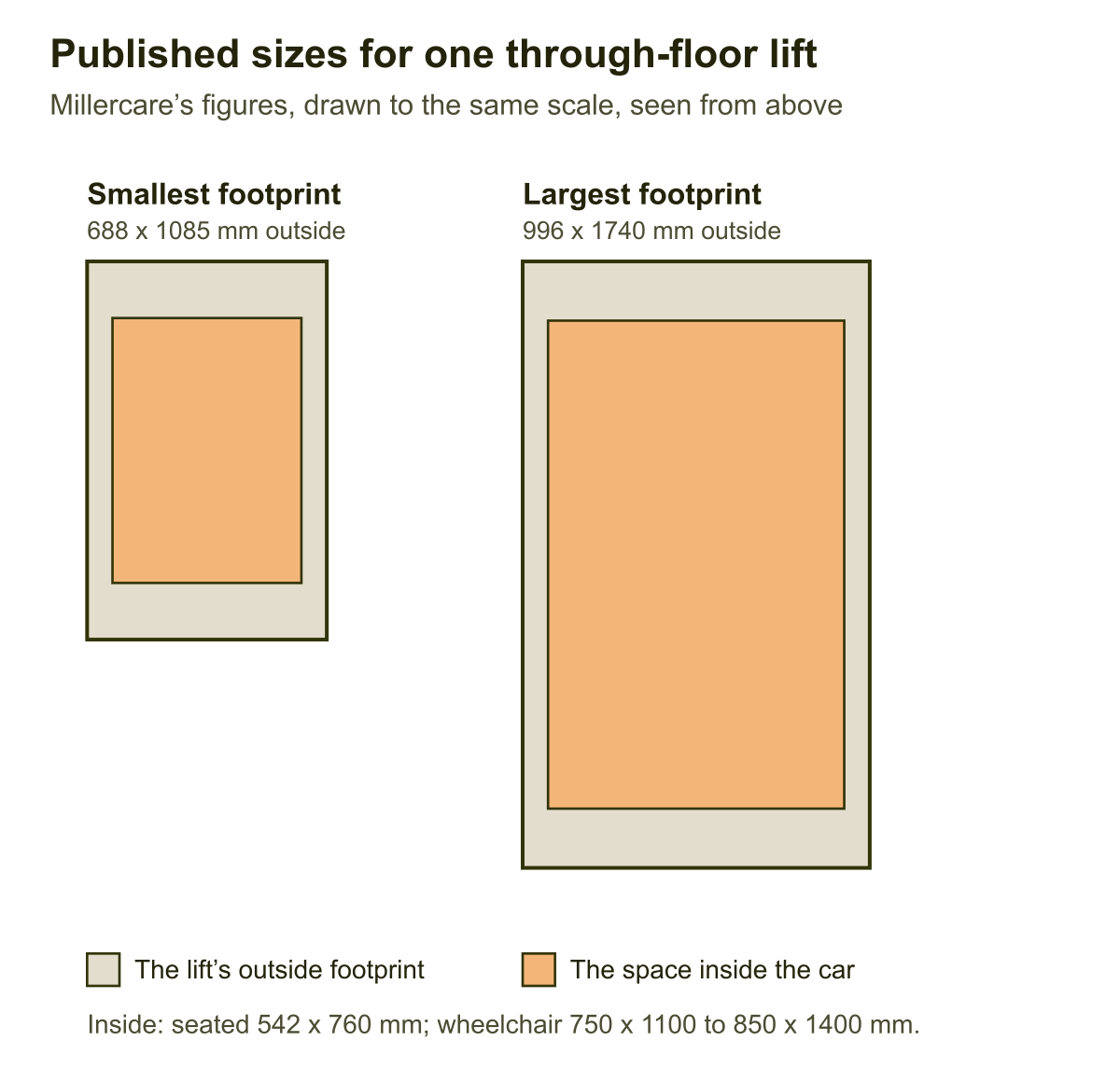
Space is the first practical question. Millercare publishes outside footprints from 688mm x 1085mm to 996mm x 1740mm, with room inside for a wheelchair from 750mm x 1100mm up to 850mm x 1400mm, or a seated car of 542mm x 760mm (Millercare, checked 13 November 2026). Drawn to the same scale, the difference is easy to see.
How a lift works and what decides whether one fits is on what is a through-floor lift, the published sizes and loads are on sizes and space, and lifts that carry a wheelchair are on wheelchair through-floor lifts.
Above the limit
When the quote is bigger than the grant
The guidance to councils in England is direct about the limit: councils are not required to pay costs above the grant maximum, but they can top grants up, as agreed locally and set out in their housing assistance policy, and can offer loans (government guidance to councils, checked 13 November 2026). A council can also use that policy to raise the upper limit itself (consultation response, checked 13 November 2026). Whether yours does is a question for its published policy, and the page on whether the council will pay explains what such policies can contain.
There are other routes. The same guidance asks councils to consider reclaiming, refurbishing and recycling lifts, including agreements under which a provider offers refurbished equipment at a discount to people who are not eligible for a grant (government guidance to councils, checked 13 November 2026); second-hand lifts covers that in more depth. And grant-giving charities can be searched in one place: Turn2us says its search connects people to over 1,700 organisations (Turn2us, checked 13 November 2026).
After it is fitted
VAT, servicing and the years after fitting
VAT first. If the lift is installed to help a disabled person move between floors of their home, no VAT is charged, and GOV.UK says the relief also covers repairing and maintaining the lift (GOV.UK, checked 13 November 2026). The detail, and who counts as disabled for the relief, is on VAT relief on lifts.
Then upkeep. A lift needs regular servicing, and the guidance to councils says the cost of an extended guarantee or service contract paid when the lift is commissioned can be included in the grant (government guidance to councils, checked 13 November 2026). One council’s own guide recommends at least an annual service for any lift and says a through-floor lift may need servicing twice a year (Derbyshire County Council, checked 13 November 2026). What contracts cover, and what to ask before signing one, is on servicing costs.
And what happens when the lift is no longer needed depends on the grant’s conditions. A council may make it a condition that specialist equipment is recovered for reuse (government guidance to councils, checked 13 November 2026), while another council’s guide tells owners that a lift fitted with a grant becomes their property, to maintain and insure (Derbyshire County Council, checked 13 November 2026). Read your own grant’s conditions; removal explains the rest.
Who runs this site
A publisher, not a lift company or a council
Home Lift Grants is published by SEO-DONS LTD, company number 16766013 on the Companies House register. It makes, sells and fits nothing, and it is not a council, a government department, the NHS or a charity, so it cannot decide or apply for a grant. It reads the rules and the published prices at their source, dates each one, and answers quote requests by email. There is no obligation to accept any quote.
How each figure was found is on sources and checks, the company behind the site is on about this site, and short answers are gathered under questions.
Questions about paying for a home lift
Not one with that name. Help with a lift in a disabled person’s home normally comes through the council’s Disabled Facilities Grant: the government’s guidance to councils in England says larger items such as through-floor lifts, which may need structural work, are normally funded that way. Scotland has its own scheme instead.
On 13 November 2026 Millercare’s own product page priced its through-floor lift at £13,995 with the VAT relief applied, and Affordable Mobility’s page priced a Pollock through-floor lift at £14,500 including VAT. Makers print starting figures: Stannah from £15,000 including building works, Stiltz from £17,000 excluding VAT. None is a full installed cost for your home, and some makers print no price at all.
It can, through the grant, if it is satisfied the lift is necessary and appropriate for the disabled person and reasonable and practicable in the building. In England the most one grant has to be is £30,000, and a council may give more under its own policy.
Not when the lift is installed to help a disabled person move between floors of their own home. GOV.UK says the relief also covers repairing and maintaining the lift.
A council does not have to pay above the maximum, but it may top a grant up or offer a loan if its housing assistance policy allows. Charities, and refurbished lifts recycled by councils, are other routes some people use.
Sources for the figures on this page
Every price, limit and rule above comes from one of these pages. If one of them has changed since we read it, tell us and we will go back to it.
- Disabled Facilities Grant (DFG) delivery: guidance for local authorities in England (gov.uk, 28 March 2022) read on 13 November 2026
- GOV.UK, Disabled Facilities Grants: eligibility read on 12 November 2026
- GOV.UK, Disabled Facilities Grants: what you’ll get read on 12 November 2026
- Disabled Facilities Grants (Maximum Amounts and Additional Purposes) (Wales) Order 2008 (legislation.gov.uk) read on 12 November 2026
- nidirect, Disabled Facilities Grants read on 13 November 2026
- Scheme of Assistance Regulations 2008 (SSI 2008/406), regulations 3 and 4, as amended in 2013 (legislation.gov.uk) read on 12 November 2026
- GOV.UK, VAT relief on certain building work if you have a disability read on 13 November 2026
- Millercare, Through Floor Lift (product page, millercare.co.uk) read on 13 November 2026
- Affordable Mobility, Pollock through the floor Home lift (product page, stairlifts2u.co.uk) read on 13 November 2026
- Vimec, How Much Does A Home Lift Cost? (vimecaccessibility.com) read on 13 November 2026
- Stannah Lifts, Residential Lifts & Domestic Lifts (stannahlifts.co.uk) read on 13 November 2026
- Pollock Homelifts, How much do Home Lifts cost in the UK? (pollockhomelifts.co.uk) read on 13 November 2026
- Stiltz, Through Floor Lifts by Stiltz - The Duo Home Lift (stiltz.co.uk) read on 13 November 2026
- GOV.UK, consultation response on Disabled Facilities Grant allocations (17 February 2026) read on 13 November 2026
- Derbyshire County Council, You and your home: a guide to looking after and getting the best from your lift (PDF, November 2024) read on 13 November 2026
- Turn2us, Apply for grants (turn2us.org.uk) read on 13 November 2026
Ask about a lift for your home
Say which floors the lift should join and whether a wheelchair is used. If a grant is in view, hold any order until the council approves it.