Through floor lift dimensions: published sizes, travel and rated loads
Through floor lift dimensions differ by model and by the size of the car. On the suppliers’ pages we could read on 13 November 2026, Millercare printed outside footprints from 688mm x 1085mm to 996mm x 1740mm and car sizes from 542mm x 760mm seated to 850mm x 1400mm for a wheelchair (Millercare, checked 13 November 2026), and Affordable Mobility gave the Pollock lift up to 4.2 metres of travel and a capacity of 255kg (Affordable Mobility, checked 13 November 2026). Makers’ own pages add more: Terry Lifts prints four Harmony FE sizes, up to 1045mm (w) x 1435mm (l) outside (Terry Lifts, checked 13 November 2026), and Stiltz says its Duo covers just 0.55m² (Stiltz, checked 13 November 2026). No page we read printed the size of the opening.
Last reviewed against its sources: 13 November 2026. Each figure links to the page it was read on.
The published figures in one table
| Figure | Millercare through-floor lift | Pollock through-floor lift (Affordable Mobility) |
|---|---|---|
| Outside footprint | 688mm x 1085mm to 996mm x 1740mm | Not printed; described as relatively compact |
| Inside, seated car | 542mm x 760mm | Seated version offered; size not printed |
| Inside, wheelchair car | 750mm x 1100mm to 850mm x 1400mm | Wheelchair versions offered; sizes not printed |
| Travel | Up to 4.2m, as an option | Up to 4.2 metres |
| Rated load | Not printed on the page | 255kg, one person |
| Opening in the floor | Not printed | Not printed |
Sources: Millercare (Millercare, checked 13 November 2026); Affordable Mobility (Affordable Mobility, checked 13 November 2026). “Not printed” means the page did not give the figure. Millercare’s specification sheet, a PDF, was not read for this site.
What makers print on their own pages
Makers’ own pages, read on 13 November 2026, give sizes, loads and travel for their own models. Each row is that one publisher’s figure, as printed.
| Maker and model | Size as printed | Rated load | Travel | Source |
|---|---|---|---|---|
| Stiltz Duo (maker) | Covers just 0.55m² | 170kg: two people standing or one sitting | 4.5 Metres | (Stiltz, checked 13 November 2026) |
| Terry Lifts Harmony FE (maker) | Four sizes, 910mm (w) x 914mm (l) to 1045mm (w) x 1435mm (l) outside | 325kg | Two floors, 3.6m | (Terry Lifts, checked 13 November 2026) |
| Pollock Homelifts (maker) | Wheelchair cars 750 x 1100 to 800 x 1400; seated 542 x 760 | 200KG for the 800 x 1400 wheelchair and side-hung cars | 4.2m, as an option | (Pollock Homelifts, checked 13 November 2026) |
| MyMob 20 Series Eco (My Mobility UK, seller) | Cars 542 x 760mm to 800 x 1400mm | Up to 255kg (200kg on larger cars) | Up to 4.2m | (My Mobility UK, checked 13 November 2026) |
| Cibes Air (maker) | 17 platform sizes | 300/400/500 kg | Not printed | (Cibes Lift, checked 13 November 2026) |
| Cibes A4000 (maker) | Headroom 2300 mm; pit 50 mm | 300 kg | Up to 15 m, two to six floors | (Cibes Lift, checked 13 November 2026) |
| TKE H100 (maker) | Pit 50mm; headroom 2430mm | 250 - 400kg | 1400 - 12000mm | (TKE Home Solutions, checked 13 November 2026) |
| Gartec, compact home lifts in general (maker’s guide) | Platforms from around 910 x 870mm to 910 x 1370mm | Not printed | Not printed | (Gartec, checked 13 November 2026) |
Outside footprint and inside space
Two sizes matter and they are easy to confuse. The outside footprint is the floor area the lift takes up in each room. The inside size is the space in the car for the person who travels. A wheelchair car needs a bigger inside, which pushes the footprint up: on Millercare’s figures the footprint ranges from 688mm x 1085mm for the compact seated car to 996mm x 1740mm for the largest wheelchair car (Millercare, checked 13 November 2026).
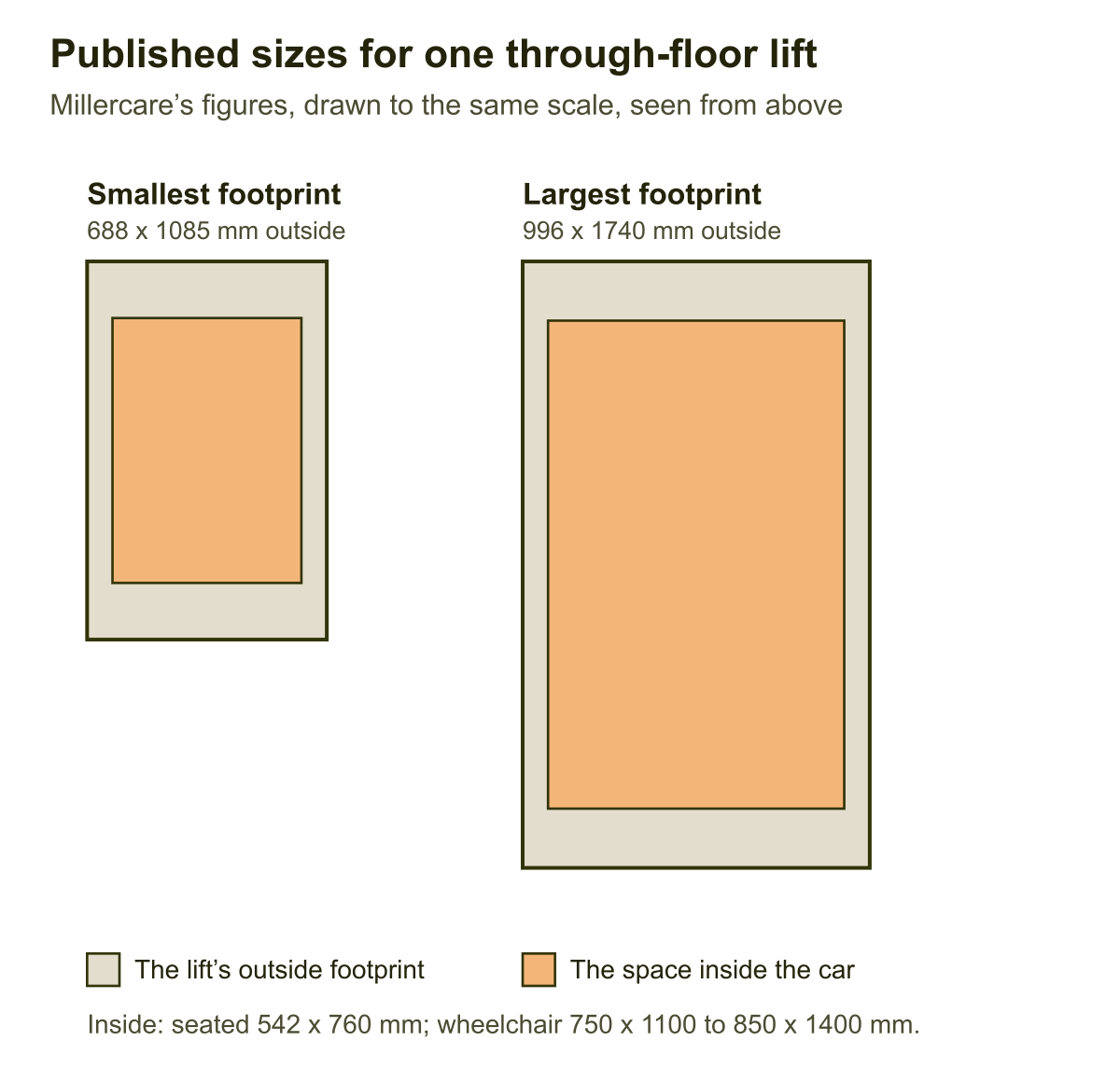
Remember that the footprint is needed twice: in the room downstairs where the car waits, and in the room directly above, where it arrives. Both rooms also need space to get in and out of the car, and a wheelchair user needs room to turn. A supplier’s survey checks this for real; the published figures tell you whether it is worth asking. Each of these terms is defined in the glossary.
What is the smallest home lift?
We can only answer for the pages we read. Stiltz says its two-person Duo “Covers just 0.55m² in surface area” and needs no wall to be fixed to (Stiltz, checked 13 November 2026). Gartec’s guide to small home lifts says entry-level platforms can start from around 910 x 870mm, as a guide rather than for one product (Gartec, checked 13 November 2026). Millercare prints 688mm x 1085mm for its compact seated car (Millercare, checked 13 November 2026), and Affordable Mobility describes the Pollock lift as relatively compact without giving the figure (Affordable Mobility, checked 13 November 2026). Other makers were not read, so we do not claim that any lift is the smallest available.
Travel between floors
Travel is how far the car rises. Affordable Mobility gives the Pollock lift up to 4.2 metres between two floors (Affordable Mobility, checked 13 November 2026), and Millercare offers extended travel to 4.2m as an option it describes as suited to higher ceilings (Millercare, checked 13 November 2026). Both pages describe lifts that join two floors. The total rise in your home, from floor to floor, is one of the first measurements a surveyor takes.
Weight limits
The rated load is the most the lift is designed to carry, and it differs a good deal between models. Affordable Mobility’s page gives the Pollock lift a maximum capacity of 255kg, carrying one person (Affordable Mobility, checked 13 November 2026), while Pollock’s own page says its 800 x 1400 wheelchair car and its side-hung car have a reduced carrying capacity of 200KG (Pollock Homelifts, checked 13 November 2026). Stiltz prints 170kg for the two-person Duo (Stiltz, checked 13 November 2026), Terry Lifts 325kg for the Harmony FE (Terry Lifts, checked 13 November 2026), and Cibes 300/400/500 kg for its Air (Cibes Lift, checked 13 November 2026). Millercare’s product page prints none.
The rated load matters for as long as the lift is in use. One council’s guide to looking after a lift says using it over the weight limit is unsafe and likely to mean more breakdowns, and that if the user’s weight has increased since fitting, the safe working load should be checked again (Derbyshire County Council, checked 13 November 2026). For a wheelchair user, ask the supplier how the rated load applies to the person and the chair together.
The opening in the floor
A through-floor lift travels through an opening made in the floor (Affordable Mobility, checked 13 November 2026), and its size depends on the model and the car. None of the pages we could read printed it. Ask for the opening size in writing at the survey, together with where it will go and what is above and below it. Whether the work needs building regulations approval is covered on installation; GOV.UK says to check with a building control body if you cannot tell (GOV.UK, checked 13 November 2026).
How size feeds into cost and the grant
A bigger car can mean a bigger opening and more building work. A maker that prints no price lists the type of lift, the preparation work and the number of floors among the things that change the cost (Vimec, checked 13 November 2026). If a council grant is involved, the council has to be satisfied the lift is necessary and appropriate and reasonable and practicable in the building (GOV.UK, checked 12 November 2026); the size of car it supports will follow from its assessment. Help with through-floor lifts normally comes through the grant (government guidance to councils, checked 13 November 2026). Costs are on through-floor lift cost, and wheelchair cars on wheelchair through-floor lifts.
Questions about lift sizes
They vary by model and car size. Millercare publishes outside footprints from 688mm x 1085mm to 996mm x 1740mm; Terry Lifts prints four Harmony FE sizes from 910mm (w) x 914mm (l) to 1045mm (w) x 1435mm (l) outside; and Stiltz says its two-person Duo covers just 0.55m².
We can only speak for the pages we read. Stiltz says its Duo covers just 0.55m², Gartec’s guide says entry-level compact platforms can start from around 910 x 870mm, and Millercare prints 688mm x 1085mm for its compact seated car. We do not claim any lift is the smallest available.
It varies by model: Stiltz prints 170kg for its two-person Duo, Affordable Mobility 255kg for a Pollock lift, Terry Lifts 325kg for its Harmony FE, and Cibes 300/400/500 kg for its Air. One council’s guide warns that using a lift over its weight limit is unsafe.
None of the pages we read printed the size of the opening. It depends on the model and the car size, so ask the supplier for it in writing at the survey.
Sources for the figures on this page
Every price, limit and rule above comes from one of these pages. If one of them has changed since we read it, tell us and we will go back to it.
- Millercare, Through Floor Lift (product page, millercare.co.uk) read on 13 November 2026
- Affordable Mobility, Pollock through the floor Home lift (product page, stairlifts2u.co.uk) read on 13 November 2026
- Derbyshire County Council, You and your home: a guide to looking after and getting the best from your lift (PDF, November 2024) read on 13 November 2026
- Vimec, How Much Does A Home Lift Cost? (vimecaccessibility.com) read on 13 November 2026
- GOV.UK, Building regulations approval: When you need approval read on 13 November 2026
- GOV.UK, Disabled Facilities Grants: eligibility read on 12 November 2026
- Disabled Facilities Grant (DFG) delivery: guidance for local authorities in England (gov.uk, 28 March 2022) read on 13 November 2026
- Stiltz, Through Floor Lifts by Stiltz - The Duo Home Lift (stiltz.co.uk) read on 13 November 2026
- Terry Lifts (Terry Group Ltd), Harmony FE Home Lift (terrylifts.co.uk) read on 13 November 2026
- Pollock Homelifts, Home Lift Range (pollockhomelifts.co.uk) read on 13 November 2026
- My Mobility UK, MyMob 20 Series Eco Through Floor Lift Home Elevator UK (mymobilityuk.co.uk) read on 13 November 2026
- Cibes Lift (UK pages), Cibes Air - Residential lifts (cibeslift.com) read on 13 November 2026
- Cibes Lift (UK pages), Cibes A4000 Home Lift (cibeslift.com) read on 13 November 2026
- TKE Home Solutions (TK Access Solutions Limited), H100 - German engineering meets Italian design - TK Home Solutions Stairlifts UK (tke-homesolutions.co.uk) read on 13 November 2026
- Gartec, Small Home Lifts for Compact Spaces (gartec.com) read on 13 November 2026