What is a through floor lift? How it works, and what decides if one fits
What is a through floor lift? It is a lift for one person that rises from one floor of a home to the next through an opening made in the floor. Affordable Mobility’s page for the Pollock lift describes it as a way to travel between two floors while staying seated or in a wheelchair, without moving onto a stair lift chair (Affordable Mobility, checked 13 November 2026). Whether one fits depends on space on both floors and on the building.
Last reviewed against its sources: 13 November 2026. Each figure links to the page it was read on.
How a through-floor lift works
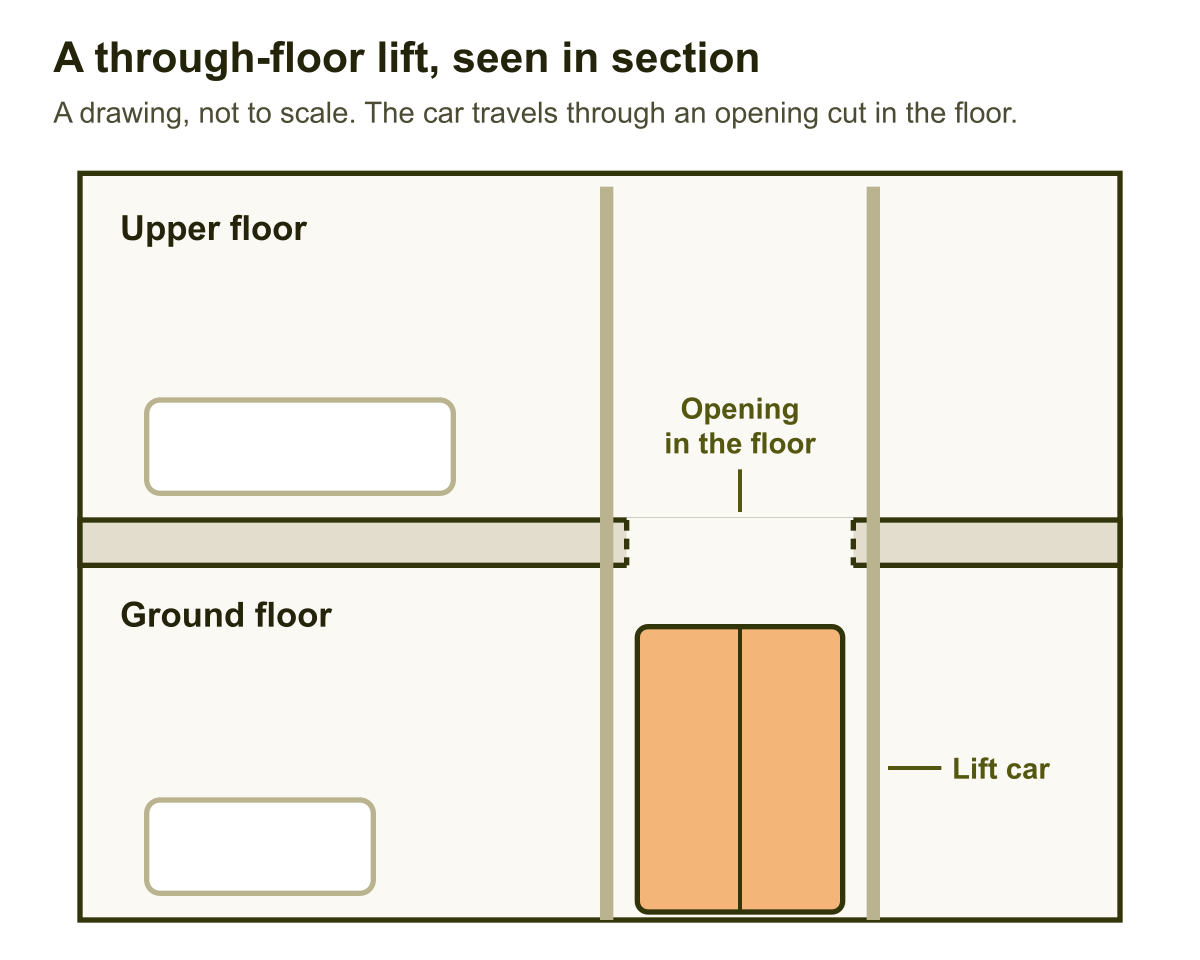
The lift car stands in a room on the lower floor. When it is called, it travels straight up through an opening in the ceiling and comes to rest in the room above. Affordable Mobility’s page says the Pollock lift travels vertically through a specially prepared opening, which gives more freedom over where it goes than a stair lift, which has to follow the stairs (Affordable Mobility, checked 13 November 2026). Millercare’s page adds that when the lift is not in use it can rest upstairs, leaving the living area below clear (Millercare, checked 13 November 2026).
| Feature | Millercare | Pollock (Affordable Mobility) |
|---|---|---|
| Versions | Wheelchair cars in several sizes; a compact seated car | Wheelchair and seated versions |
| Travel | Up to 4.2m, as an option | Up to 4.2 metres between two floors |
| Starting and stopping | Soft start and stop; self-levelling | Soft start and stop; self-levelling |
| Controls | Illuminated controls; remote call stations | Illuminated controls in the car; remote call stations |
| Power cuts | Battery backup | Battery backup |
Sources: Millercare (Millercare, checked 13 November 2026); Affordable Mobility (Affordable Mobility, checked 13 November 2026).
The suppliers’ pages describe the same everyday features: controls inside the car, call points on each floor, a soft start and stop, self-levelling at each floor, and battery backup (Millercare, checked 13 November 2026) (Affordable Mobility, checked 13 November 2026). Affordable Mobility gives the Pollock lift up to 4.2 metres of travel between two floors, and Millercare offers extended travel to 4.2m as an option for higher ceilings.
Seated or wheelchair
The first choice is the size of the car. A seated car carries the user sitting down; a wheelchair car is large enough for the user to stay in the chair. Millercare publishes a compact seated car of 542mm x 760mm inside and wheelchair cars from 750mm x 1100mm to 850mm x 1400mm (Millercare, checked 13 November 2026), and the Pollock lift is offered in both forms (Affordable Mobility, checked 13 November 2026). The larger the car, the larger the footprint on both floors: the published sizes are compared on sizes and space, and wheelchair cars on wheelchair through-floor lifts.
Through-floor lift or stair lift?
GOV.UK’s examples of what the grant can pay for name a stairlift (GOV.UK, checked 12 November 2026), and many homes are adapted that way. A through-floor lift answers a different need. Affordable Mobility’s page, which sells both, says a through-floor lift can offer advantages where wheelchair access or easier transfers are the priority, while a stair lift remains a good choice for many customers (Affordable Mobility, checked 13 November 2026). If a council is involved, the choice is made in its assessment, against its tests: the work must be necessary and appropriate for the person, and reasonable and practicable in the building (GOV.UK, checked 12 November 2026).
Can I put a lift in my house?
Four questions decide it, and a supplier’s survey answers them for a particular home.
- Is there room on both floors? The lift needs its footprint in a room downstairs and directly above it upstairs, with space to get in and out.
- Can the floor take an opening? That depends on how the house is built. Affordable Mobility’s page says the Pollock lift’s self-supporting design can reduce the structural alterations needed compared with many conventional lift systems (Affordable Mobility, checked 13 November 2026).
- Does the work need approval? GOV.UK’s list of alterations that might need building regulations approval does not name lifts, but it says you could need approval for work not listed, and to check with a building control body if you cannot decide (GOV.UK, checked 13 November 2026).
- Who has to agree? In a rented home, the landlord; under the Equality Act 2010 a landlord cannot unreasonably withhold consent to an adaptation (government guidance to councils, checked 13 November 2026).
What fitting involves, without the engineering, is on installation.
Paying for one
The guidance to councils in England says larger items such as through-floor lifts, which may need structural work, are normally funded through the Disabled Facilities Grant (government guidance to councils, checked 13 November 2026), and the law’s purposes for the grant include access to a room for sleeping and to a bathroom (1996 Act, section 23, checked 13 November 2026). Installing a lift to help a disabled person move between floors carries no VAT (GOV.UK, checked 13 November 2026). Published prices are on through-floor lift cost, and how councils decide is on will the council pay?
A maker that prints no price says the type of lift, the preparation work and the number of floors all change the cost (Vimec, checked 13 November 2026), so a survey comes before any firm figure.
After it is fitted
A lift is a machine that needs looking after. One council’s guide recommends at least a yearly service for any lift and twice a year for a through-floor lift (Derbyshire County Council, checked 13 November 2026), and says a lift fitted with a grant became the owner’s property, to maintain and insure (Derbyshire County Council, checked 13 November 2026). Other councils set other conditions, so check yours. More on servicing and on home lifts for older people; words such as travel, footprint and rated load are explained in the glossary.
Questions about through-floor lifts
A small lift for one person that travels between two floors of a home through an opening made in the floor. Suppliers offer seated versions and versions large enough for a wheelchair user to stay in the chair.
It depends on the space on both floors and on the building. A supplier’s survey answers the practical question; GOV.UK says to check with a building control body if you cannot tell whether the work needs approval.
A stair lift carries a seated person along the staircase; a through-floor lift rises vertically through the floor, and some take a wheelchair. Affordable Mobility’s page presents its through-floor lift as an alternative where wheelchair access or easier transfers matter.
Both suppliers whose pages we read describe battery backup. Ask any supplier what its lift does if the mains supply fails, and how the battery is checked.
Sources for the figures on this page
Every price, limit and rule above comes from one of these pages. If one of them has changed since we read it, tell us and we will go back to it.
- Affordable Mobility, Pollock through the floor Home lift (product page, stairlifts2u.co.uk) read on 13 November 2026
- Millercare, Through Floor Lift (product page, millercare.co.uk) read on 13 November 2026
- Vimec, How Much Does A Home Lift Cost? (vimecaccessibility.com) read on 13 November 2026
- GOV.UK, Building regulations approval: When you need approval read on 13 November 2026
- Disabled Facilities Grant (DFG) delivery: guidance for local authorities in England (gov.uk, 28 March 2022) read on 13 November 2026
- GOV.UK, Disabled Facilities Grants: eligibility read on 12 November 2026
- GOV.UK, Disabled Facilities Grants: overview read on 12 November 2026
- legislation.gov.uk, Housing Grants, Construction and Regeneration Act 1996 (c. 53), section 23 read on 13 November 2026
- Derbyshire County Council, You and your home: a guide to looking after and getting the best from your lift (PDF, November 2024) read on 13 November 2026
- GOV.UK, VAT relief on certain building work if you have a disability read on 13 November 2026